How to write an SEO article brief: a 7-point checklist
A good SEO article starts with a brief, not with the text. A brief is a short assignment that tells the writer who the article is for, which search query it should rank for and what the reader should do at the end. The clearer the brief, the fewer the revisions and the sooner the article starts bringing in visitors.
Here are seven points that cover most jobs, from a blog post to a category page.
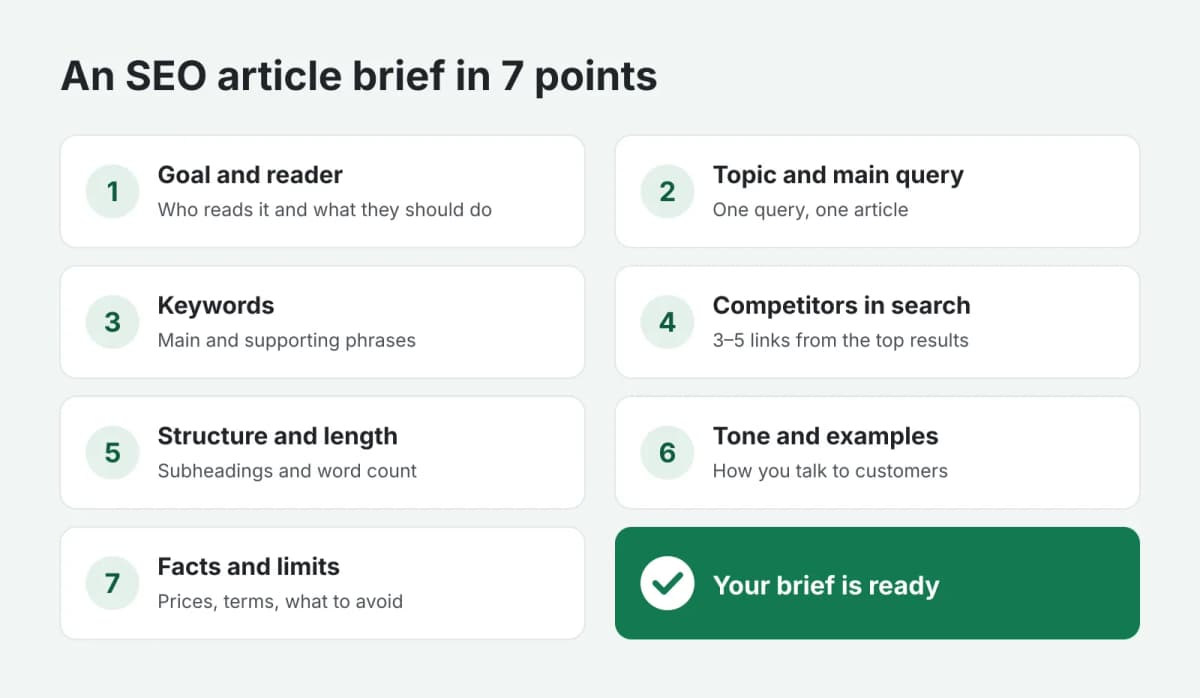
1. Goal and reader
Describe in two or three sentences who will read the article and why. "Online store owners choosing a payment provider" is good. "Anyone interested" is not: a text written for everyone usually works for no one.
State the action you want right away: request a quote, open the catalog, subscribe to a newsletter. The structure and the call to action at the end depend on it.
2. Topic and main query
One article, one main search query. If you want to cover "how to choose a laptop" and "best laptops of 2026" at once, those are two articles: the queries have different intent, and search engines show different pages for them.
Write the query the way people type it, for example "how to choose a laptop for college".
3. Keywords
Add 5–15 supporting phrases that expand the topic: synonyms, refinements, common questions. They do not need to appear word for word in a row; the writer will spread them naturally across subheadings and paragraphs.
If you do not have a keyword list yet, start with keyword research: it also shows which topics deserve articles of their own.
4. Competitors in search
Search for your main query and pick 3–5 pages from the first ten results. Note what they do well and what they miss. The aim is not to rewrite competitors but to make your piece more complete and useful: add an example, a table, step-by-step instructions or fresh data.
5. Structure and length
Sketch an outline of H2 and H3 subheadings, or ask the writer to propose one. Give an approximate length. Do not chase word count: the article should answer the reader's question fully, and not a paragraph more.
6. Tone and examples
Link to one or two texts whose style you like and describe how you talk to customers: formal or casual, strict or friendly. That alone saves a whole round of revisions.
7. Facts and limits
List what must be exactly right in the text: prices, terms, product names, addresses. Separately, list what must not be written: promises you do not make, competitor names, legally sensitive wording.
How to approve the finished article
When the article is ready, check it against the same brief:
- does it answer the main query in the first paragraphs;
- does it have the subheadings and the key phrases from your list;
- are the facts, prices and terms correct;
- is it clear what the reader should do next.
If something is off, describe the change precisely: "section two needs a B2B example" works better than "make it livelier". On Dleex every package includes revisions, and payment is released only after you approve the work.
In short
A seven-point brief takes 15–20 minutes and saves days of back and forth. Keep this list as a template and fill it in for every new article. And once your brief is ready, order a ready-to-publish SEO article with meta tags.