How to turn your expertise into an online course: the module structure

Many experts have enough knowledge for a course, but get stuck at the first question: where do I start, and in what order do I explain it all? The answer is the structure. Build it before you write a single lesson, and the course becomes a series of small, manageable pieces.
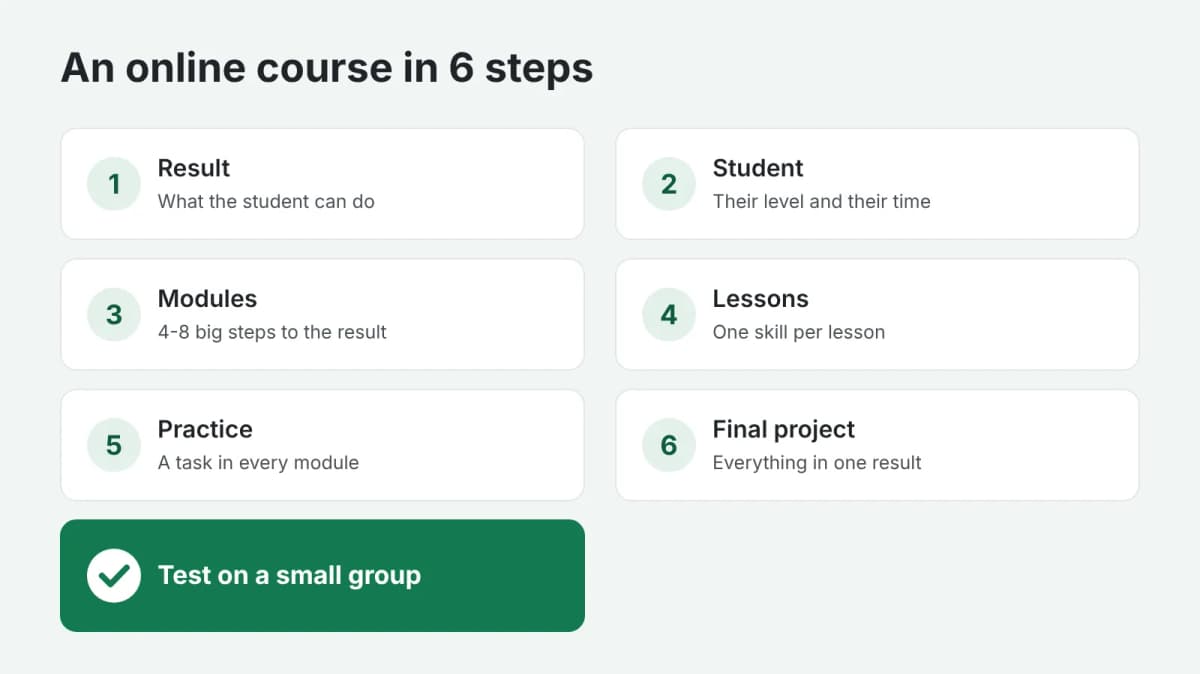
1. Start with the result
Finish the sentence: "After the course, the student will be able to ...". Use a concrete action, not "understand" or "learn about": "set up their first ad campaign", "bake sourdough bread at home", "build a monthly budget in a spreadsheet". This result is the filter for everything else: whatever does not lead to it goes into another course.
2. Describe the student
Who they are, what they already know and what they do not, how much time they have per week. A course for beginners and a course for practitioners on the same topic are two different courses.
3. Split the result into modules
A module is a big step towards the result. Ask: what does the student have to be able to do before the final result is possible? Usually four to eight modules are enough.
Example for a course on sourdough bread:
- Tools and ingredients
- Growing and keeping a starter
- The first simple loaf
- Shaping and scoring
- Baking and common mistakes
- Variations: rye, whole wheat, additions
4. Split modules into lessons
One lesson, one skill or one idea. Short lessons of five to fifteen minutes of reading or video are easier to finish and easier to come back to. Give each lesson a title that says what the student will get from it.
5. Add practice to every module
Knowledge without practice fades within days. Each module ends with a task that brings the student one step closer to the result: a checklist, an exercise, a short quiz, a small project. Practice also shows you where the course is unclear.
6. Keep students to the end
- A quick win in the first lesson, so the student feels progress immediately.
- Visible progress: numbered modules, a checklist of completed lessons.
- A final project that combines everything and gives the student something to show.
7. Test before you scale
Run the course for a small group first, collect questions and see where people drop out. Those places need a shorter lesson, an example or an extra exercise.
In short
A clear result, a known student, four to eight modules, short lessons and practice in every module: this structure turns expertise into a course people finish. If you want help with the writing, order online course content: you describe the topic and the audience, and get a course program or ready lesson texts with assignments and quizzes. Payment is released only after you approve the work.