Restoring old photos: what can be fixed and what cannot

Old family photos fade, crack and collect stains, and often there is only one copy. Restoration can bring many of them back: remove scratches, repair tears, restore contrast and even add color. But it has limits, and knowing them helps you choose the right photos and prepare them well.
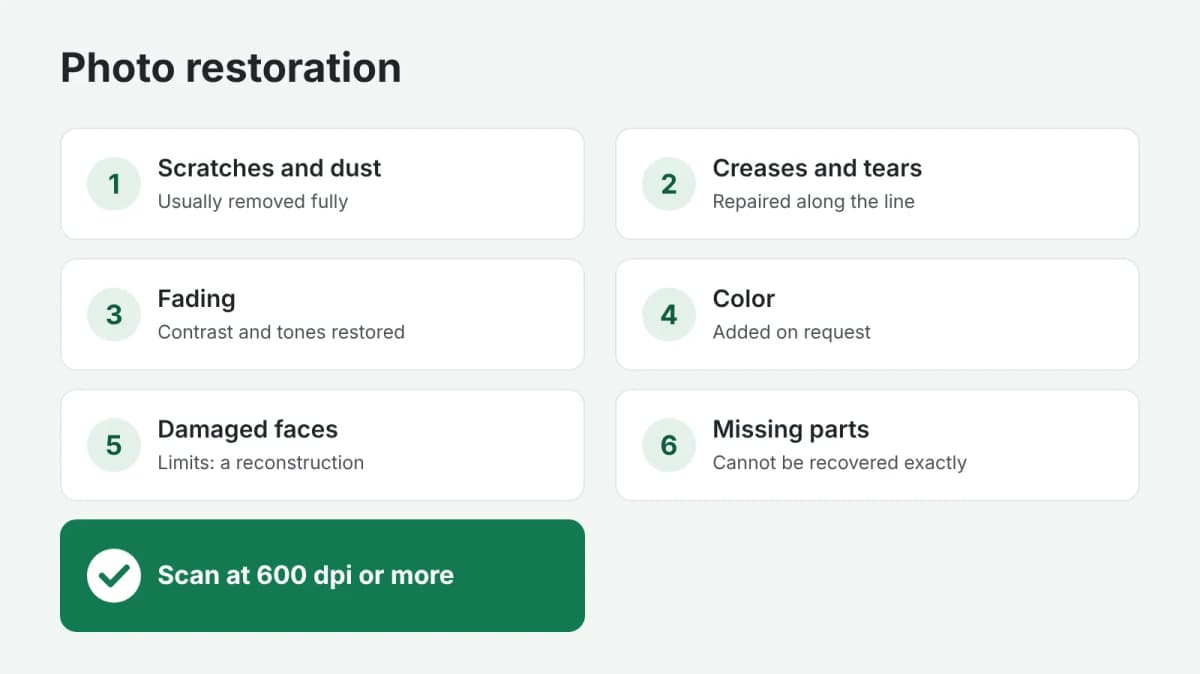
What can usually be fixed
- Scratches, dust and small spots. The most common damage, and the easiest to remove.
- Creases and tears, when the parts on both sides of the line are still visible.
- Fading and yellowing. Contrast and natural tones can be brought back.
- Stains from water, tape or glue, if they do not cover the main details.
- Small missing pieces of the background or edges, which can be filled in to match.
- Black-and-white to color. Colorizing is possible on request; the colors are a careful interpretation, not a record of the original.
What has limits
- Faces that are badly damaged or very blurred. The face can be repaired, but the less is visible, the more the result is a reconstruction and the less it may look like the person.
- Large missing parts. If half of a face or a figure is gone, it cannot be recovered exactly.
- Very small faces in group photos. Each face has only a few pixels of information.
- Out-of-focus or motion-blurred originals. Sharpness can be improved, but detail that never reached the film cannot be invented reliably.
Always compare the result with the original, and ask family members who knew the people to check the faces.
How to scan an old photo
The scan is the starting point of the restoration, so it matters:
- Use a flatbed scanner if you can, rather than a phone camera.
- 600 dpi or more for normal prints, 1200 dpi for small ones.
- Scan in color, even black-and-white photos: color keeps more tones.
- No filters or auto-correction. Send the scan as it is.
- Clean the glass of the scanner and remove dust from the print with a soft brush.
- Do not flatten or glue torn or curled prints yourself.
If you only have a phone, shoot in daylight, straight above the photo, without a flash and without the shadow of the phone.
Keep the original
Restoration gives you a new digital copy, not a new print of the old one. Store the original in an envelope or archival box, away from light and moisture, and keep the scan and the restored file in two places.
In short
Scratches, creases, fading and stains can usually be fixed; badly damaged faces and missing parts have limits. A good scan makes all the difference. If you have photos to bring back, order old photo restoration: you upload your scans, and get cleaned and refreshed photos, colorized if you ask. Payment is released only after you approve the work.