SEO audit: the 10 most common issues it finds
A site can be good-looking and useful and still get almost no visitors from search. Most often the reason is not the content but technical details the owner never sees: pages blocked from indexing, duplicates, slow loading. An SEO audit finds these issues and sorts them by priority.
Here are the ten issues an audit finds most often, and how to check each one yourself.
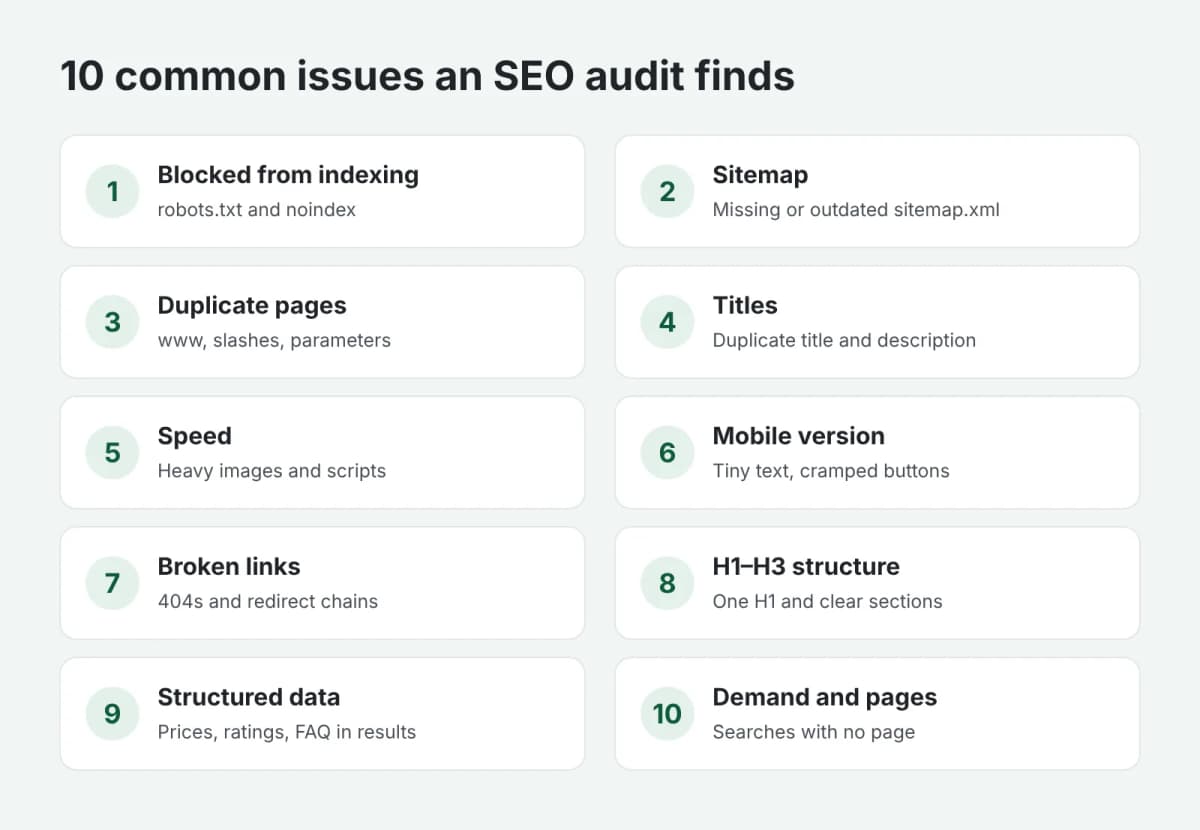
1. Pages blocked from indexing
Sometimes a rule in robots.txt or a noindex meta tag is left over from development, and search engines simply do not see part of the site. To check, open your-site/robots.txt and look for a Disallow: / line for all robots. Search engines' webmaster tools also have a report on excluded pages.
2. A missing or outdated sitemap
The sitemap.xml file tells search engines which pages your site has. A common mistake is a sitemap that still lists deleted pages or misses new ones. It should update automatically.
3. Duplicate pages
The same page is available at several addresses: with and without a trailing slash, with and without www, with sorting parameters. Search engines waste time on them and may pick the wrong address. The fix is redirects to one main address plus a canonical tag.
4. Duplicate or empty titles
Every page needs its own title and description. If a hundred product pages share the title "Buy online", search engines struggle to tell them apart, and people struggle to pick the right one in the results.
5. Slow loading
Heavy images, extra scripts and slow hosting cost you both rankings and customers. Test your site in Google PageSpeed Insights, paying special attention to the mobile version and to LCP, the time it takes for the main element of the screen to appear.
6. A poor mobile version
Most searches now happen on phones. Tiny text, buttons that are hard to tap and horizontal scrolling are signals that pull rankings down. Open your site on a phone and try to place an order with one hand.
7. Broken links and redirect chains
Links to pages that no longer exist (404 errors) annoy visitors and waste the search robot's time. Chains of several redirects in a row slow loading down. A site crawler finds them in one pass.
8. Weak heading structure
A page should have one H1 heading, with sections marked up as H2 and H3. When headings are used just for a bigger font, it is harder for search engines to understand what the page is about.
9. No structured data
Structured data helps search engines show prices, ratings, FAQs or breadcrumbs right in the results. These snippets stand out and get more clicks. You can check your markup with the Rich Results Test.
10. Pages nobody searches for, and searches with no page
It happens that half of a site's pages answer no real query, while what customers are looking for is not on the site at all. This is where keyword research helps: it shows which pages are missing.
What a good audit should give you
A good audit is not a list of two hundred remarks; it is a work plan. It should include:
- what is wrong, with examples of specific pages;
- why it matters: how the issue affects rankings or sales;
- how to fix it: clear instructions for a developer or content manager;
- priority: what to do first and what can wait.
In short
Most issues on this list take a few days to fix, and the effect builds up over months. If you want a full list of your site's issues with a plan to fix them, order an SEO audit. Packages are based on the number of pages, and payment is released only after you approve the report.