How to write a website specification and get what you need

Most website projects that go over budget or come out "not quite right" have the same cause: the client and the developer understood the task differently. A specification, the written description of what the site must do, prevents that. It does not have to be long or technical, but it has to be clear.
Here is what to put in a specification for a website, section by section.
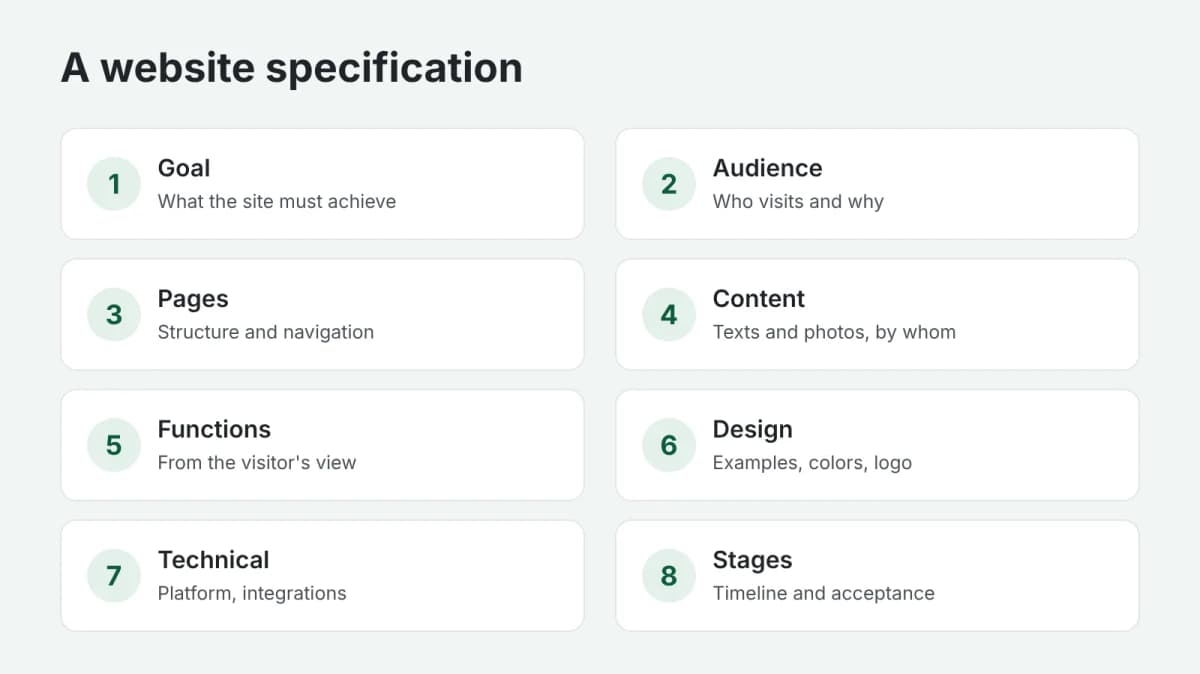
1. Goal of the site
What the site is for and how you will know it works: "collect requests for kitchen design consultations, at least 30 a month". Without a goal, every decision becomes a matter of taste.
2. Audience
Who visits the site and what they want to do there. A busy business owner on a phone and a student comparing prices on a laptop need different things.
3. Pages and structure
A list of pages and how they connect: home, catalog, product page, about, contacts, blog. A simple diagram or a list with nesting is enough.
4. Content of each page
What each page contains: blocks, texts, photos, forms. Mark who provides each piece: you or the developer. Content is the most common reason projects stall.
5. Functions
What the site must do: online payment, booking, search and filters, a personal account, multiple languages. Describe each function from the visitor's point of view: "a visitor picks a date and time and gets a confirmation email".
6. Design
Examples of sites you like and why, your brand colors and logo, fonts if you have them. If there is no design yet, say whether it is part of the job.
7. Technical requirements
The platform or CMS, if you have a preference; hosting and domain; integrations with your CRM, payment provider or delivery service; requirements for speed and mobile devices.
8. Timeline, stages and acceptance
Break the work into stages with a result at each: design, layout, functions, content, launch. Agree in advance how each stage is accepted and how many rounds of changes are included.
Common mistakes
- "Like that site, but better." A link without explanation leaves the developer guessing what exactly you like.
- Forgetting the content. A site without texts and photos cannot launch, even if the code is ready.
- Changing the scope mid-project. New wishes are normal, but each one should be added to the specification, with its effect on time and cost.
In short
A good specification answers what the site is for, who uses it, which pages and functions it has and how the result is accepted. It takes a few hours and saves weeks of rework. If you want it written for you, order a technical specification: you describe your idea, and get a document that any developer can estimate and build from. Payment is released only after you approve the work.