How to order a translation: literal, adaptation or localization
"Just translate it" is how most translation orders begin, and why many end in disappointment. A contract, a product page and an advertising slogan need very different kinds of translation. Choose the right one and prepare a few things in advance, and the result will read as if it had been written in that language.
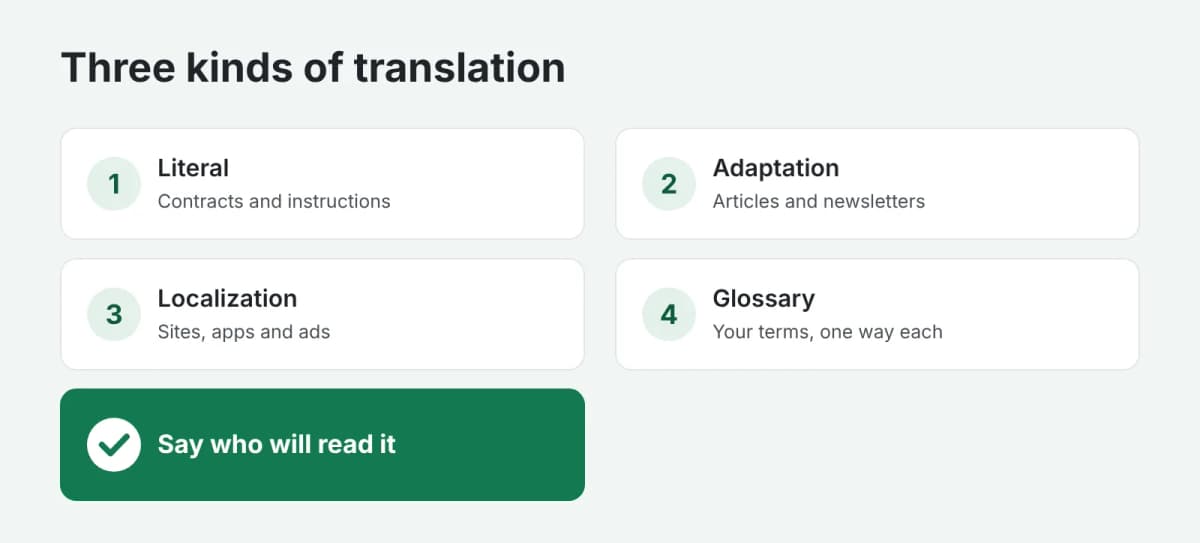
Three kinds of translation
Literal (close) translation
As close to the original as the target language allows: the same structure, the same terms, nothing added or dropped.
Use it for: contracts, instructions, technical documents, official letters, anything where precision matters more than style.
Adaptation
The meaning and tone stay; sentences, idioms and examples are rewritten so they sound natural to the reader. A joke that does not work in the other language is replaced by one that does.
Use it for: articles, blog posts, newsletters, presentations, product descriptions.
Localization
Adaptation plus everything that depends on the country: currency and prices, units of measurement, date formats, addresses, local examples, cultural references, sometimes even the pictures.
Use it for: websites, apps, online stores, ads aimed at a specific country.
What to send with the text
- The audience. Who will read it: customers, partners, engineers, children.
- The country. Spanish for Spain or for Mexico, Portuguese for Portugal or Brazil, English for the UK or the US: the differences matter.
- A glossary. Your product names, terms and phrases that must be translated one way, or not translated at all.
- Earlier translations. If parts of your site are already translated, send them, so the new text uses the same words.
- Text in an editable format. A document or a table works better than a screenshot or a scanned page.
How to check the result
- Read it aloud or ask a native speaker to: unnatural phrasing is easy to hear.
- Check names, numbers, dates and prices against the original.
- Look at the text where it will live: on the page, in the app, on the package. Translations are often longer than the original and may not fit the design.
Common mistakes
- Ordering a literal translation for marketing texts: correct, but nobody wants to read it.
- Sending text without context: the same word can be translated in several ways.
- Changing the original after the translation has started.
In short
Decide what kind of translation you need, send the context and a glossary, and check the result in its place. When the text is ready, order a translation: you choose the languages and the style, and get an accurate translation with a glossary of your terms. Payment is released only after you approve the work.